If
you have ever seen “3rd & 7” in the corner of a football broadcast and
wondered what it meant, you are not alone. Downs are the single most important
idea in American football. They decide when a team keeps the ball, when it
gives it up, and why coaches agonize over one play on fourth down. Once you
understand downs, every drive starts to tell a story. Here is how they work.
What is a down?
The NFL defines a down as “the period of
action that begins when the ball is put in play and ends when the ball is
declared dead,” according to its official glossary.
In simple terms, a down is one play.
The offense gets four downs to gain 10
yards. If it succeeds, it earns a first down and a fresh set of four
downs. If it fails, it usually gives the ball to the other team.
What does “1st & 10” mean?
The graphic on a football broadcast
always shows two numbers:
•
The down: which of the four plays the
offense is on (1st, 2nd, 3rd or 4th).
•
The distance: how many yards the offense
still needs to reach a first down.
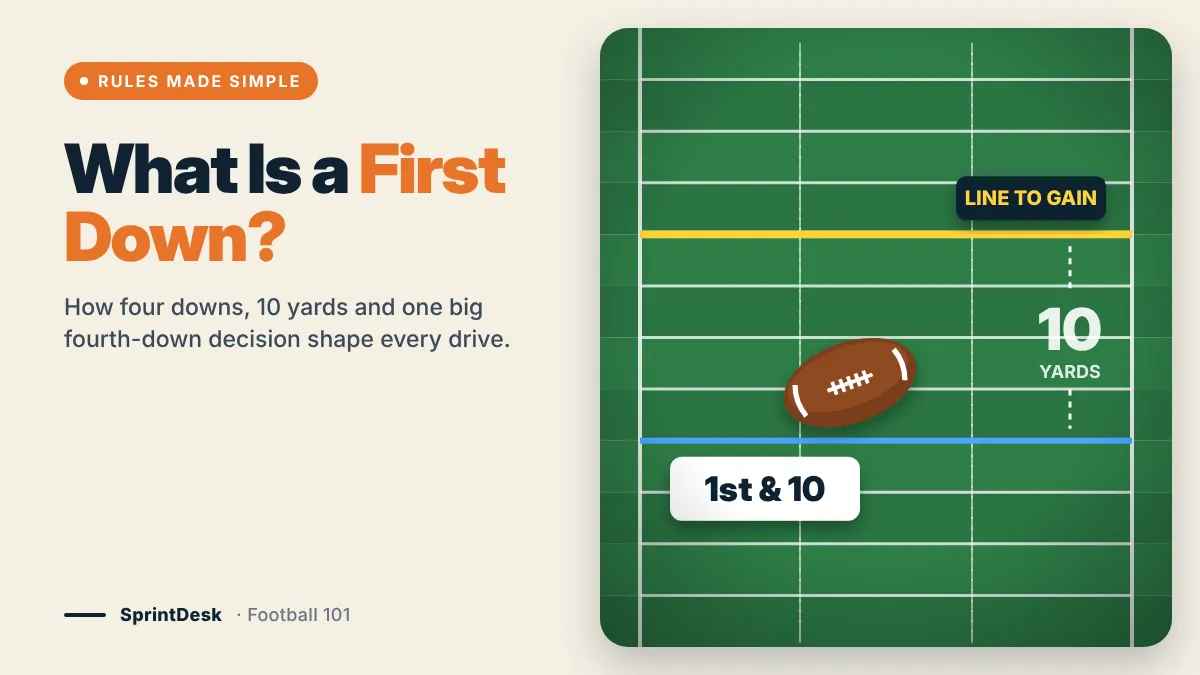
So “1st & 10” means it is the
first play of a new set and the offense needs 10 yards. “3rd & 2” means it
is the third play and the offense needs only two more yards. The NFL calls the
spot the offense must reach the line to gain. On TV, broadcasters
usually show it as a colored line across the field.
An example drive, play by play

Example football drive from
1st and 10 to a new first down
Here is how a typical series
works:
1.
1st & 10. The running back gains 4
yards. The offense now needs 6.
2.
2nd & 6. A short pass gains 3 yards.
The offense needs 3.
3.
3rd & 3. The quarterback completes a
5-yard pass. That is past the line to gain.
4.
New 1st & 10. The downs reset, and
the offense gets four more chances to gain another 10 yards.
Notice that the offense does
not need to gain exactly 10 yards. Any play that reaches or passes the line to
gain earns a new first down, and a single long play can cover several first
downs at once.
What happens on fourth down?
Fourth down is where football
strategy gets interesting. If the offense has not reached the line to gain
after three plays, it has three options:
|
Option |
What happens |
When teams usually choose
it |
|
Punt |
Kick the ball to the other
team to push them back |
Far from the opponent’s end
zone |
|
Field goal |
Try to kick the ball through
the goalposts for 3 points |
Close enough for the
kicker’s range |
|
Go for it |
Run a normal play to reach
the line to gain |
Short distance needed, or
trailing late in the game |
If the offense goes for it and
falls short, the result is a turnover on downs: the other team takes
over the ball at the spot where the play ended, the NFL explains. That is why
going for it deep in your own territory is so risky. A failure gives the
opponent great field position.
How are first downs measured?
On every NFL sideline, a crew
of eight home-team workers known as the chain crew uses a 10-yard chain
to mark where the series started and where the line to gain is, according to
the NFL glossary. When a play ends very close to the line, officials bring the
chains onto the field for a measurement. If the front tip of the ball reaches
the stick, it is a first down.
Other ways to earn a first down
Gaining 10 yards is the
usual route, but some defensive penalties also give the offense an automatic
first down, even if the yardage is short. Officials announce this after the
penalty is enforced.
Why downs make football so strategic
Downs turn every
drive into a series of small decisions. On first down, offenses have the most
freedom and can try almost anything. On second down, the play call depends on
how much the first play gained. Third down is often called the “money down,” because
failing usually means punting the ball away. And fourth down forces coaches to
weigh risk against reward in front of millions of viewers.
Our take: the one number new fans
should watch
If you are
learning the game, keep your eyes on the distance number in the corner of the
screen. “3rd & 1” and “3rd & 12” are completely different situations.
With one yard to go, the offense can run the ball and has many options. With 12
yards to go, almost everyone in the stadium knows a pass is coming, and the
defense can play accordingly. Once you start reading down and distance before
every snap, you will begin predicting play calls, and that is when football
becomes truly fun to watch.
Frequently asked questions
How many downs do you get in
football?
Four. The offense has four
downs to gain 10 yards and earn a new first down.
What does “3rd and long”
mean?
It means the offense is on
third down and still needs a lot of yards, often seven or more, to get a first
down.
What is a turnover on downs?
It happens when the offense
goes for it on fourth down and fails to reach the line to gain. The other team
takes over at that spot.
Why do teams punt on fourth
down?
Punting pushes the other team
farther back. It is often safer than risking a turnover on downs in your own
territory.
What is the yellow line on
TV football broadcasts?
It is a graphic that shows the
line to gain, the spot the offense must reach for a first down. It is not
painted on the field.
Sources
1.
NFL Football Operations – Terms glossary – definitions of down, first down, line to gain,
line of scrimmage, chain crew, turnover on downs, punt and field goal.