NFL positions explained: what every player on the field does
If you are new to American football, the hardest part is often not the rules but the people. Twenty-two players are on the field at once, and each one has a specific job. Once you know who does what, the game becomes much easier to follow. This guide explains every position on offense, defense and special teams in plain English.
How many players are on the field?
Each team is allowed 11 players on the field at a time, according to the NFL Football Operations glossary. That means 22 players are on the field for every play: 11 on offense (the team with the ball) and 11 on defense.
Teams also use special teams units for kicking plays. NFL rosters are large because few players play every down; most are specialists who come on and off the field depending on the situation.
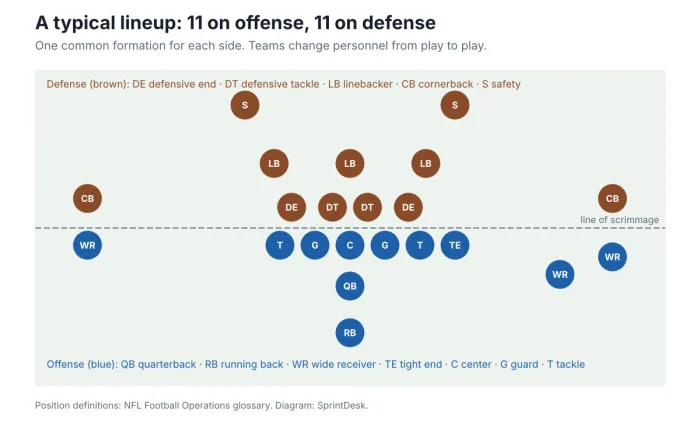
Diagram of a typical NFL offensive and defensive lineup
Offense: the team with the ball
The offense tries to move the ball down the field and score. Its players fall into three groups: the quarterback, the ball carriers and receivers, and the offensive line.
Quarterback (QB)
The quarterback is the leader of the offense. He calls the play in the huddle, takes the snap from the center and then hands the ball off, throws a pass or runs with it himself. Because nearly every play goes through his hands, the quarterback is usually the most important player on the team.
Running back (RB)
Also called a halfback or tailback, the running back lines up behind the quarterback and is the main ball carrier on running plays. Running backs also catch short passes and help block for the quarterback.
Fullback (FB)
The fullback is a bigger back who lines up behind the quarterback, often in front of the running back. His main job is to block and clear a path, but he may carry the ball when the offense needs only a yard or two. Many modern offenses use a fullback only in certain situations.
Wide receiver (WR)
Wide receivers line up near the sidelines and run routes down the field to catch passes. They are usually among the fastest players on the field. An offense typically uses two to four receivers on a play.
Tight end (TE)
The tight end lines up at the end of the offensive line. It is a hybrid position: on running plays he blocks like a lineman, and on passing plays he can run a route and catch the ball.
Offensive line: center, guards and tackles
Five linemen form a wall in front of the quarterback:
• Center (C): snaps the ball to the quarterback and tells the other linemen whom to block.
• Guards (G): two players on either side of the center who block pass rushers and open lanes for runners.
• Tackles (T): two players on the outside of the line who protect the quarterback, especially from fast pass rushers on the edges.
Offensive linemen rarely touch the ball, but games are often won or lost by how well they block.
Defense: the team trying to stop them
The defense tries to stop the offense, force a punt and take the ball away. It has three layers: the defensive line, the linebackers and the defensive backs.
Defensive line: ends and tackles
• Defensive tackles (DT): line up across from the guards and push into the middle of the offensive line to stop runs and pressure the quarterback.
• Defensive ends (DE): line up on the outside of the defensive line. Their main job is to rush the quarterback and stop runs to the outside.
A play where a defender tackles the quarterback behind the line before he can throw is called a sack.
Linebackers (LB)
Linebackers stand a few yards behind the defensive line. They are the defense’s most versatile players: they tackle running backs, cover receivers and tight ends on passing plays, and sometimes rush the quarterback. The middle linebacker often calls the defensive play.
Cornerbacks (CB)
Cornerbacks line up across from the wide receivers and try to stop them from catching passes. They need speed, quick reactions and the ability to turn and run with a receiver.
Safeties (S)
Safeties are the last line of defense. They line up deep in the secondary, about 10 to 15 yards from the ball, to stop long passes and tackle any runner who breaks through. Teams often have a free safety, who focuses on deep passes, and a strong safety, who plays closer to help against the run.
Cornerbacks and safeties together are called defensive backs or the secondary.
Special teams: the kicking game
Special teams take the field for kickoffs, punts, field goals and extra points.
• Placekicker (K): kicks field goals, extra points and kickoffs.
• Punter (P): comes in on fourth down, when the offense is not trying for a first down or field goal, and kicks the ball deep to the other team.
• Long snapper: a specialist center who snaps the ball accurately to the holder or punter on kicking plays.
• Holder: catches the long snap and places the ball on the ground for the kicker. This is often the punter.
• Returners: catch kickoffs and punts and try to run them back.
Common formations: why the lineup changes
The diagram above shows one common setup, but the mix of players changes from play to play. On an obvious passing down, an offense may use four or five receivers. Near the goal line, it may bring in an extra tight end or a fullback to block. Defenses respond by swapping a linebacker for an extra defensive back against passing formations, or adding linemen against heavy running formations. Watching which players run onto the field before a play is one of the easiest ways to guess what is coming.
Our take: where new fans should look
When you start watching football, the ball moves so fast that it is easy to miss the action. Our suggestion: on each play, pick one matchup and follow it from the snap to the whistle. Watch a receiver against his cornerback on passing downs, or the offensive line against the defensive line on running downs. After a few games, you will start to see why certain plays work and why others fall apart, and the positions will make far more sense than any diagram can show.
Frequently asked questions
How many players are on an NFL team’s field at once?
Eleven per team, so 22 in total on each play.
What is the most important position in football?
Most coaches and analysts would say quarterback, because he handles the ball on almost every offensive play.
What is the difference between a cornerback and a safety?
Cornerbacks cover wide receivers near the line of scrimmage. Safeties play deeper and protect against long passes and runs that break through.
What does a long snapper do?
He snaps the ball back to the holder or punter on field goals, extra points and punts. Accuracy matters, because a bad snap can ruin a kick.
Can a player play both offense and defense?
It is allowed, but it is rare in the modern NFL. Most players specialize in one side of the ball.
Sources
1. NFL Football Operations – Terms glossary – definitions of each position and the 11-player rule.