Thirty-two
teams, two conferences, eight divisions and a schedule that changes every year:
the structure of the NFL can feel like a puzzle to new fans. Why does Dallas
play in the “East”? Why do some teams meet twice a season and others only once
every few years? Once you understand how the league is organized, standings
tables, rivalries and even the Super Bowl matchup suddenly make sense. Here is
a clear guide.
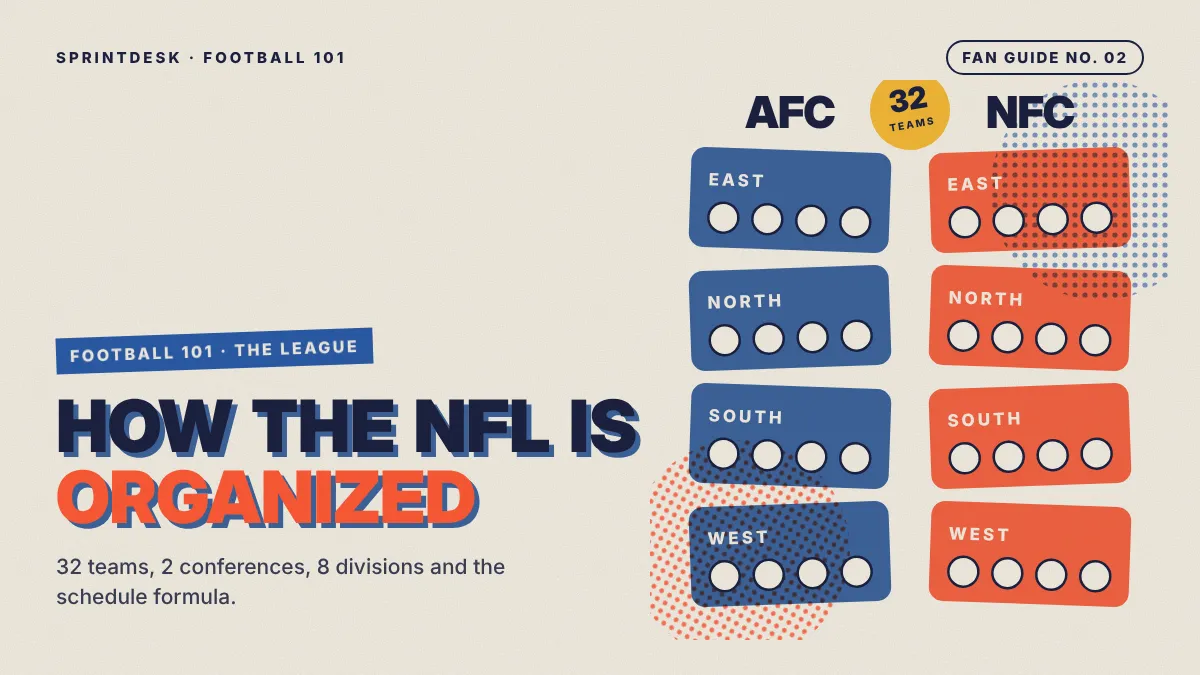
The basic structure: 32 teams, 2
conferences, 8 divisions
The NFL has 32
teams split into two conferences of 16 teams each: the American Football
Conference (AFC) and the National Football Conference (NFC). Each
conference has four divisions, named East, North, South and West, and “every
division has four teams,” according to NFL Football
Operations.
|
Division |
AFC |
NFC |
|
East |
Buffalo Bills,
Miami Dolphins, New England Patriots, New York Jets |
Dallas Cowboys,
New York Giants, Philadelphia Eagles, Washington Commanders |
|
North |
Baltimore
Ravens, Cincinnati Bengals, Cleveland Browns, Pittsburgh Steelers |
Chicago Bears,
Detroit Lions, Green Bay Packers, Minnesota Vikings |
|
South |
Houston Texans,
Indianapolis Colts, Jacksonville Jaguars, Tennessee Titans |
Atlanta
Falcons, Carolina Panthers, New Orleans Saints, Tampa Bay Buccaneers |
|
West |
Denver Broncos,
Kansas City Chiefs, Las Vegas Raiders, Los Angeles Chargers |
Arizona
Cardinals, Los Angeles Rams, San Francisco 49ers, Seattle Seahawks |
Source: Wikipedia –
National Football League, team table.
At the end of
each season, the AFC champion and the NFC champion meet in the Super Bowl.
Where did the AFC and NFC come from?
The two conferences
are a legacy of the AFL-NFL merger. When the leagues combined in 1970, the
former AFL teams formed the core of the AFC, joined by three old NFL teams
(Baltimore, Cleveland and Pittsburgh), while the remaining NFL teams formed the
NFC, according to the Pro Football Hall of
Fame. Our history of how
the NFL started covers that story in detail.
That is why the
Steelers, Browns and Colts (then in Baltimore), all NFL clubs before the
merger, play in the AFC today.
Why the current divisions look
the way they do
The
eight-division layout dates to 2002. That year, the Houston Texans
joined as an expansion team, bringing the league to 32 teams, and the NFL
reorganized into four divisions of four teams in each conference, according to Wikipedia’s
summary of the 2002 season. Before that,
each conference had three divisions.
The map is not
perfectly geographic, largely because of history:
•
Dallas in the NFC East. The Cowboys
stayed in the same division as the Giants, Eagles and Washington, even though
Texas is far from the East Coast.
•
Indianapolis in the AFC South. The Colts
moved from the AFC East to the new AFC South in 2002.
•
Seattle in the NFC West. The Seahawks
moved from the AFC West to the NFC West in the same realignment.
Since 2002, teams
have changed cities and names, but the division structure itself has stayed the
same.
How the schedule formula works

How the NFL builds a
17-game schedule: division, rotation and standings-based games
The NFL does not let teams
pick their opponents. A fixed rotation decides who plays whom. Under the
current formula, each team plays 17 regular-season games over 18 weeks,
built like this, according to NFL Football Operations:
|
Games |
Opponents |
How they are chosen |
|
6 |
The three division
rivals, home and away |
Every season |
|
4 |
All four teams in another
division of the same conference |
Rotates on a three-year
cycle |
|
4 |
All four teams in a
division of the other conference |
Rotates on a four-year
cycle |
|
2 |
One team from each of the
two remaining same-conference divisions |
Based on last season’s
division finish |
|
1 |
One team from a division
in the other conference |
Based on last season’s
division finish |
The rotation ensures every
team plays each of the other 31 teams at least once in a four-year period, the
NFL says. The two “finish-based” games mean a division winner usually meets
other division winners the following season, while a last-place team gets other
last-place teams.
The NFL can adjust the
number of regular-season games over time, but the logic of the formula, six
division games plus rotations, has been the backbone of the schedule for years.
Why divisions matter so much
Division games are worth more
than their single win or loss. Every team plays its three division rivals
twice, so those six games make up more than a third of the schedule. Division
standings also play a major role in who reaches the playoffs and how the next
season’s schedule is built. That is why fans circle division games first when
the schedule comes out, and why rivalries like Bears–Packers or Cowboys–Eagles
feel so intense.
Our take: learn your team’s
division first
If you are new to
the NFL, do not try to memorize all 32 teams at once. Start with your favorite
team’s division. You will see those three rivals twice every season, the
standings race will make sense within a few weeks, and the history behind each
rivalry will give every game more meaning. Once you know one division well, the
other seven are easy to follow, because they all work the same way.
Frequently asked questions
How many teams are in the
NFL?
Thirty-two, split evenly
between the AFC and NFC.
How many divisions are in
the NFL?
Eight: East, North, South and
West in each conference, with four teams per division.
How many games does an NFL
team play in a season?
Under the current formula, 17
regular-season games, including six against its division rivals.
Why is Dallas in the NFC
East?
The Cowboys were already in the
NFC East with the Giants, Eagles and Washington, and the 2002 realignment kept
them there.
Who plays in the Super Bowl?
The champion of the AFC plays
the champion of the NFC.
Sources
1.
NFL Football Operations – Creating the NFL
schedule – conferences, divisions, the 17-game formula and
the four-year rotation.
2.
NFL Football Operations – 2026 opponents
determined – three-year and four-year rotation cycles and
standings-based games.
3.
Wikipedia – National Football League – team list by division and the 2002 change from
three to four divisions per conference.
4.
Wikipedia
– 2002 NFL season – the Houston Texans expansion and team moves in
the realignment.
5.
Pro Football Hall of Fame – 1970 – the merged league and the formation of the AFC
and NFC.