Watching
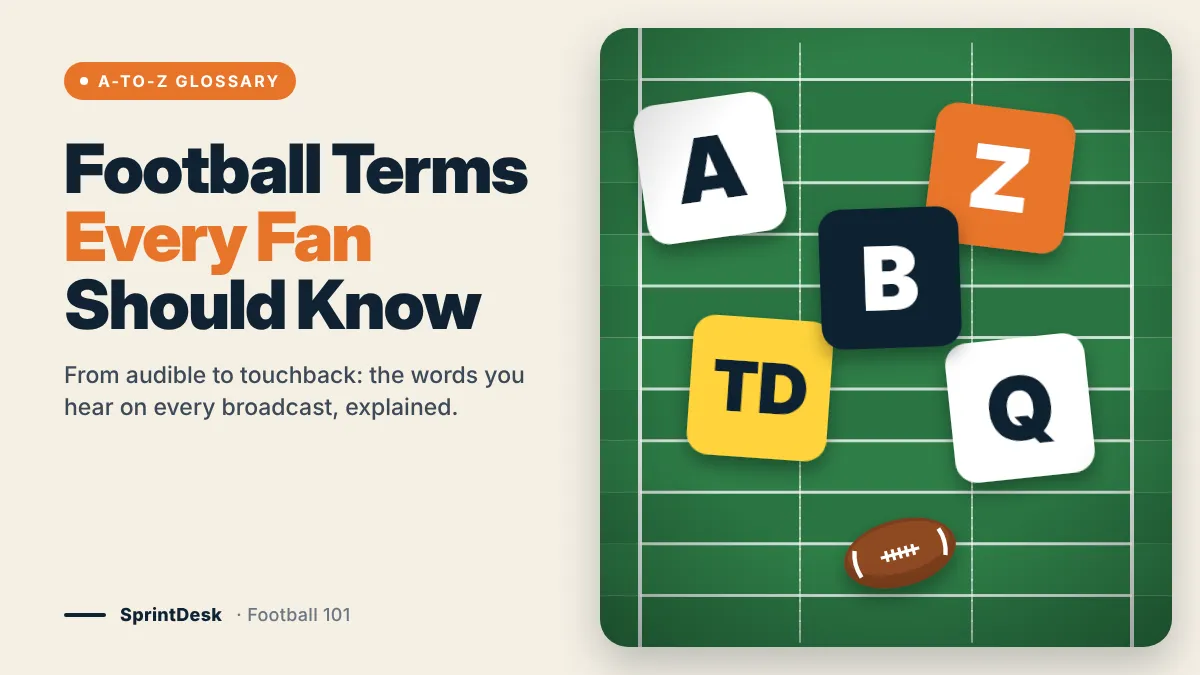
your first few football games can feel like listening to a foreign language.
Announcers talk about the “red zone,” the “pocket” and a “touchback” as if
everyone already knows what they mean. The good news is that a few dozen words
cover almost everything you will hear. This glossary explains the most common
football terms in plain English, grouped from A to Z, with official definitions
from the NFL Football
Operations glossary wherever the
league provides one.
Start here: 10 terms you will
hear in every game

The 10 football
terms you will hear in almost every game
If you only have
a few minutes, learn these first. They come up on nearly every drive, and most
other terms build on them.
A to F
Audible. A play the quarterback changes at
the line of scrimmage, usually by shouting a new call after seeing how the
defense is lined up.
Blitz. When the defense sends extra players,
often linebackers or defensive backs, to rush the quarterback instead of
covering receivers.
Down. “The period of action that begins when
the ball is put in play and ends when the ball is declared dead,” according to
the NFL. The offense gets four downs to gain 10 yards. See our full guide to
how downs work.
End zone. The 10-yard area at each end of
the field. A player must carry the ball into it, or catch the ball in it, to
score a touchdown.
Extra point. After a touchdown, the scoring
team can kick the ball through the uprights for one more point.
Fair catch. A player receiving a punt can
raise one arm above his head to signal a fair catch. He cannot be hit, but he
also cannot run with the ball after catching it.
First down. The first of a new set of four
downs. Gaining 10 yards earns the offense a new first down.
Fumble. A turnover that can occur when any
player with the ball drops it during a play. Either team can recover it.
G to M
Hail Mary. A long, desperate pass thrown
toward the end zone, usually on the last play of a half or game, in the hope
that someone on the offense catches it.
Hash marks. Short lines on the field that
mark each yard between the larger yard lines. Every play starts on or between
the hash marks.
Huddle. The quick meeting players hold on
the field before a play to share the call.
Interception. A turnover that occurs when a
defensive player catches a pass thrown by the offense.
Kickoff. A kick that puts the ball in play
at the start of each half and after scores.
Line of scrimmage. An imaginary line,
running from sideline to sideline, that passes through the front point of the
ball before a play. Neither team may cross it until the snap.
N to R
Neutral zone. The space between the two
lines of scrimmage, as long as the football itself. Only the center may be in
it before the snap.
Offside. A penalty when a player is in the
neutral zone or beyond it when the ball is snapped or kicked.
Penalty. A punishment, usually lost yards,
given when a team breaks a rule. Officials signal one by throwing a yellow
flag.
Pick six. An interception that the defense
returns for a touchdown, worth six points.
Play action. A fake handoff to a running
back before the quarterback throws a pass. It is designed to make the defense
expect a run.
Pocket. The protected area the offensive
line forms around the quarterback so he has time to throw.
Punt. A kick, usually on fourth down, used
to push the other team back when the offense does not expect to score or get a
first down.
Red zone. The area between the opponent’s
20-yard line and its goal line. Teams in the red zone have a strong chance to
score.
S to Z
Sack. When a defender tackles the
quarterback behind the line of scrimmage before he can throw a pass.
Safety. Both a position and a score. As a
score, it is worth 2 points to the defense, usually when it tackles the ball
carrier in his own end zone.
Shotgun. A formation in which the
quarterback lines up several yards behind the center instead of directly under
him. It gives him more time to see the field on passing plays.
Snap. The action that starts every play: the
center hands or tosses the ball back between his legs to the quarterback,
holder or punter.
Touchback. When the ball is downed in the
end zone after a kick, or goes out of the end zone. Instead of a return, the
receiving team starts its drive from a set spot on the field.
Touchdown. The biggest score in football,
worth 6 points, made by carrying or catching the ball in the opponent’s end
zone.
Turnover on downs. When the offense fails to
gain the needed yards by fourth down, the other team takes over at the spot of
the last play.
Two-minute warning. An automatic timeout
near the end of each half, when two minutes remain on the game clock.
Two-point conversion. After a touchdown, the
offense can run one play from the 2-yard line. If it scores, it earns two
points instead of one.
Our take: how to learn football
terms faster
Reading a
glossary helps, but the fastest way to learn football language is to connect
each word to something you see. During your next game, pick three terms from
this list and listen for them. When the announcer says “shotgun,” look at where
the quarterback is standing. When you hear “red zone,” check the yard line on
screen. After two or three games, you will notice that the broadcast suddenly
makes sense, and these words will feel as natural as “goal” or “foul” in other
sports.
Frequently asked questions
What is the difference
between a fumble and an interception?
A fumble happens when a player
drops the ball; an interception happens when a defender catches a pass. Both
are turnovers that give the other team the ball.
What does “red zone” mean in
football?
It is the area inside the
opponent’s 20-yard line, where the offense is close enough to score.
What is a sack?
A sack is when the defense
tackles the quarterback behind the line of scrimmage before he throws.
What does “pick six” mean?
It is an interception returned
for a touchdown by the defense.
Why do officials throw
yellow flags?
A yellow flag signals a
penalty. The officials then announce which rule was broken and how many yards
are marked off.
Sources
1.
NFL Football Operations – Terms glossary – official definitions of down, end zone, fair
catch, fumble, huddle, interception, kickoff, line of scrimmage, neutral zone,
offside, penalty, pocket, punt, snap, touchback, two-minute warning, extra
point and two-point conversion.
2.
NFL Football Operations – Video rulebook: scoring
plays – touchdown, safety and try values.