An NFL field looks simple on TV: green grass, white lines and a pair of yellow goalposts. Look closer, though, and every mark has a job. The numbers tell players where they are, the short hash marks decide where each play starts, and even the distance between the goalposts is connected to the rest of the field. This guide walks through the official dimensions of an NFL field, line by line, so you know exactly what you are looking at the next time you watch a game.
How big is an NFL football field?

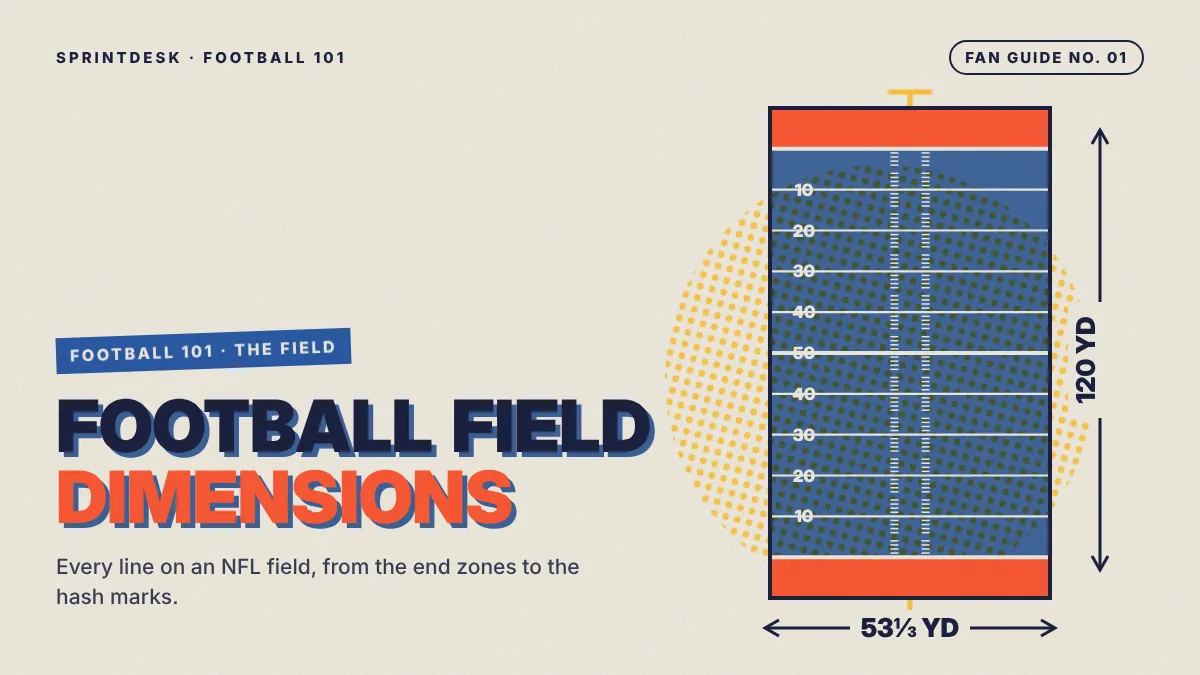
Diagram of NFL football
field dimensions with measurements
An NFL field is a
rectangle 120 yards long and 53⅓ yards wide, or 360 feet by 160 feet,
including both end zones. The space between the two goal lines, where most of
the game is played, is exactly 100 yards. The NFL calls that area the field
of play.
|
Part of the field |
Official size |
|
Whole field, including
end zones |
120 yards × 53⅓ yards
(360 ft × 160 ft) |
|
Field of play (goal
line to goal line) |
100 yards |
|
Each end zone |
10 yards deep × 53⅓
yards wide |
|
Hash marks |
70 ft 9 in from each
sideline |
|
Goalpost crossbar |
10 ft above the ground |
|
Space between the
uprights |
18 ft 6 in |
|
Border around the field |
Solid white, 6 ft wide |
Sources: NFL Football
Operations glossary, NFL rulebook, Rule 1 and Wikipedia – American
football field.
For a sense of scale, the
whole field covers 57,600 square feet, or about 1.3 acres.
The end zones
Each end of the field has an end zone,
the scoring area where a player must carry or catch the ball to score a
touchdown. According to the NFL glossary, each end zone measures “10 yards by
53 ⅓ yards.” It is bounded by the goal line at the front, the end
line at the back and the sidelines on each side.
One detail confuses many new fans: the goal
line belongs to the end zone. If the ball touches or breaks the plane of the
goal line while a runner has it, the play is a touchdown. Orange pylons sit at
the corners of each end zone to help officials judge close plays near the
edges.
Yard lines and numbers
Yard lines run across the field
from sideline to sideline. The NFL says they are “painted at five-yard
intervals parallel to the goal lines,” and short marks between them show each
single yard.
The big white numbers appear every
10 yards: 10, 20, 30, 40, then 50 at midfield, before counting back down to 10
on the other side. Next to the numbers 10 through 40, small arrows point toward
the nearer goal line, so a viewer can tell which half of the field the ball is
in. Because the numbers count down from the middle, broadcasters say a team is
at “its own 30” or “the opponent’s 30.”
The NFL also marks a short line at
the 2-yard line. That is where the ball is snapped for a two-point
conversion after a touchdown. Read our guide to how scoring works in football
for more on the try.
Hash marks: where every play starts
The two rows of short
lines down the middle of the field are the hash marks, also called
inbounds lines. In the NFL, they are 70 feet 9 inches from each sideline. Every
play starts on or between the hash marks. If a play ends near the sideline,
officials move the ball to the nearer hash mark before the next snap.
Here is a detail most
fans never notice. Subtract both hash distances from the field’s 160-foot width
and you get 18 feet 6 inches, exactly the space between the goalpost uprights.
In other words, NFL hash marks line up with the goalposts. College football
places its hash marks 60 feet from each sideline, so they are 40 feet apart,
which leaves kickers with tougher angles from the edges.
The goalposts
NFL goalposts stand behind the end line, at
the very back of each end zone. The NFL glossary describes them as “a crossbar
10 feet off the ground and two 35-foot tall uprights that are 18 feet 6 inches
apart,” painted yellow and topped with orange streamers that show the wind
direction.
The goalposts have not always been there. In
early NFL seasons, they stood on the goal line. Since 1974, NFL rules have
placed them at the end line, according to the history summarized in Wikipedia’s article on the football field.
Moving them back made every field goal attempt 10 yards longer.
Sidelines and the bench area
The playing field is
surrounded by a solid white border six feet wide along the sidelines and end
lines, the NFL rulebook says. A player who steps on the white sideline is out
of bounds.
Beyond the border is the team
area. Under NFL field rules, player benches can be placed anywhere between the
two 30-yard lines, and no benches or rigid fixtures may be closer than 10 yards
to the sidelines. That spacing protects players who run out of bounds at full
speed.
Why is a football field called a
gridiron?
Early football
fields were marked with lines running in both directions, so from above they
looked like a grid, or the grate of a cooking gridiron. The nickname “gridiron”
for the field and the sport came from that pattern in the 1880s, and it stuck
long after the field markings changed.
Our take: three marks worth watching
New fans tend to watch
only the ball, but three field markings explain a lot about strategy. Watch the
hash mark the ball is placed on before each play: an offense on the left
hash has a short side and a wide side, and play calls often target the wide
side. Watch the yard numbers: inside the opponent’s 20, the field
shrinks and defenses get tougher. And watch the goalposts’ distance from the
ball: because they stand 10 yards behind the goal line, a field goal is
always about 17 yards longer than the yard line suggests. Once you start
reading the field this way, coaching decisions make far more sense.
Frequently asked questions
How long is a football field
in yards?
An NFL field is 120 yards long
including both end zones. The field of play between the goal lines is 100
yards.
How wide is a football
field?
53⅓ yards, or 160 feet.
How deep is an end zone?
Ten yards, from the goal line
to the end line.
How far apart are the
goalposts?
The uprights are 18 feet 6
inches apart, and the crossbar is 10 feet off the ground.
Why is a field goal 17 yards
longer than the line of scrimmage?
The goalposts stand 10 yards
behind the goal line at the back of the end zone, and the holder usually sets
the ball about seven yards behind the line of scrimmage.
Sources
1.
NFL Football Operations – Terms glossary – end zone, end line, goal line, goalposts, hash
marks, yard lines, field of play.
2.
NFL Football Operations – NFL rulebook, Rule 1:
The Field – border, line widths, hash mark distance, pylons
and bench area.
3.
Wikipedia – American football field – overall dimensions in feet, yard numbers and
arrows, 2-yard line, goalpost history and the “gridiron” name.