Few
things stop a football game faster than a yellow flag. One moment a receiver is
celebrating a long catch; the next, the referee is switching on his microphone
and the play is wiped away. For new fans, penalties are often the most
confusing part of the sport. The good news is that a handful of fouls account
for most of the flags you will see, and each one follows a simple logic. This
guide explains the common NFL penalties, how many yards each one costs, and why
they matter.
What happens when an official
throws a flag?
A penalty is a
rule violation by either team, and an official signals it by throwing “a yellow
flag on the field,” according to the NFL Football
Operations glossary. The NFL calls
its officials “the third team on the field,” and a crew has seven of them.
After the play,
the officials meet, decide what happened and which team fouled, and the referee
announces the call. Referees have worn microphones since 1975 so they can
explain calls to players, broadcasters and fans, the NFL notes in its guide to
officials’ signals.
Most penalties
move the ball backward against the team that fouled. Some also take away a down
from the offense or give the offense an automatic first down.
NFL penalties by yardage: a quick
cheat sheet

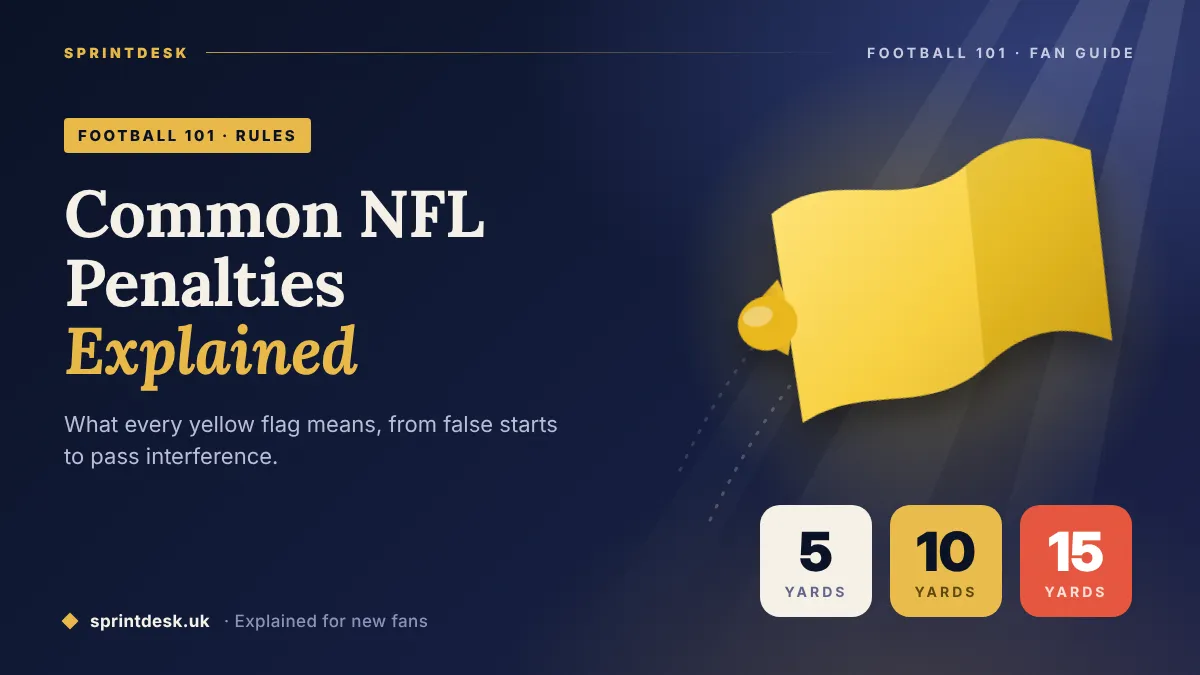
Cheat sheet of
common NFL penalties grouped by 5, 10 and 15 yards
The simplest way
to learn penalties is to group them by how many yards they cost. The values
below come from the penalty summary in the NFL
rulebook and the NFL’s video rulebook.
|
Yards |
Common
penalties |
|
5 yards |
False start,
offside, encroachment, neutral zone infraction, delay of game, illegal
formation, defensive holding (plus an automatic first down) |
|
10 yards |
Offensive
holding, offensive pass interference, intentional grounding (plus loss of
down) |
|
15 yards |
Roughing the
passer, face mask, unnecessary roughness, horse-collar tackle |
|
Spot of the
foul |
Defensive pass
interference (plus an automatic first down) |
As a rule of
thumb, small mistakes before the snap cost 5 yards, fouls that change a play
cost 10, and dangerous contact costs 15.
Penalties before the snap
These fouls happen before the
play even starts, which is why officials often blow the whistle right away.
False start (5 yards,
offense). An offensive player who is set at the line moves suddenly before
the snap. Linemen are the usual culprits, especially in loud stadiums where
they struggle to hear the quarterback.
Offside (5 yards, defense).
The NFL says a player is offside when any part of his body is in the neutral
zone, the space between the two lines of scrimmage, when the ball is snapped.
Encroachment and neutral zone
infraction (5 yards, defense). Encroachment is called when a defender
enters the neutral zone and touches an offensive player or the ball before the
snap. A neutral zone infraction is called when a defender moves into the
neutral zone and causes an offensive player to flinch.
Delay of game (5 yards). The
offense must snap the ball before the play clock runs out. The NFL glossary
explains that it has 40 seconds between plays, or 25 seconds after certain
stoppages.
Illegal formation (5 yards,
offense). The offense must line up with at least seven players on the line
of scrimmage. Lining up the wrong way draws a flag.
Holding: the most common call on
the field
Holding is the
penalty fans hear most often. On offense, the NFL video rulebook says a blocker
may not use his hands or arms to “materially restrict an opponent” or change a
defender’s path. Offensive holding costs 10 yards.
On defense, a
player may not tackle or hold any opponent “other than a runner.” Defensive holding costs only 5
yards, but it comes with an automatic first down, which can keep a drive alive.
The referee’s
signal is easy to spot: he grips one wrist just below a clenched fist.
Pass interference
Pass interference covers illegal contact
while a pass is in the air. According to the NFL video rulebook, the rule applies “from the time the
ball is thrown until the ball is touched,” and it covers defenders more than
one yard past the line of scrimmage.
Defensive pass interference is
one of the costliest fouls in football. Instead of a set number of yards, the
offense gets the ball where the foul happened, plus a first down. A 40-yard
pass that draws the flag can mean a 40-yard gain. If the foul happens in the
end zone, the ball is usually placed at the 1-yard line.
Offensive pass interference is
called when a receiver pushes off or blocks a defender while the ball is in the
air. It costs 10 yards.
Personal fouls: 15 yards for
player safety
The 15-yard
penalties are mostly about protecting players. The referee’s signal for a
personal foul is one wrist striking the other above his head.
•
Roughing the passer: a hit on the
quarterback that is late or otherwise illegal after he throws. The penalty is 15 yards and
an automatic first down, and a flagrant foul can get the player ejected.
•
Face mask: grabbing and twisting an
opponent’s face mask while tackling.
•
Unnecessary roughness: contact that goes
beyond normal football, such as hitting a player who is out of the play.
•
Horse-collar tackle: pulling a runner
down by grabbing the inside of his collar or shoulder pads.
Intentional grounding
When a quarterback is about to be
sacked, he cannot simply throw the ball away into an empty area to avoid the
loss. That is intentional grounding. The penalty is a loss of down plus
10 yards, or the spot of the pass if that is farther back. If the quarterback
is in his own end zone when he throws, the result is a safety, worth 2 points
to the defense.
Can a team decline a penalty?
Yes. The team that was fouled
usually gets a choice. If the play itself turned out better than the penalty
would, it can decline the flag and keep the result. For example, if the defense
holds a receiver but the offense still completes a 30-yard pass, the offense
will usually decline the 5-yard penalty. The referee signals a declined penalty
by folding his arms, the NFL explains.
Two other rules are good to
know:
•
Half the distance to the goal. When a
penalty would move the ball more than halfway to the offending team’s goal
line, the yardage is usually cut to half the distance instead.
•
Offsetting penalties. When both teams
foul on the same play, the penalties often cancel out and the down is replayed.
Our take: watch the flag, then
watch the down
New fans often
focus on the yards, but the smartest way to understand a penalty is to look at
what it does to the down. A 5-yard false start on 1st & 10 is a small
setback. A 10-yard holding call that turns 3rd & 2 into 3rd & 12 can
end a drive. And a defensive foul with an automatic first down can rescue a
drive that was about to stall. Next time a flag flies, check the down and
distance on screen before and after the call, and you will see why coaches
react so strongly to some penalties and barely notice others.
Frequently asked questions
What is the most common
penalty in the NFL?
Holding and false starts are
among the calls fans see most often. Offensive holding costs 10 yards; a false
start costs 5.
How many yards is pass
interference?
Defensive pass interference has
no fixed yardage. The offense gets the ball at the spot of the foul with a
first down. Offensive pass interference costs 10 yards.
What does “automatic first
down” mean?
Some defensive fouls, such as
defensive holding and roughing the passer, give the offense a new set of downs
no matter how many yards it still needed.
Why do teams decline
penalties?
When the result of the play is
better than the penalty yardage, the team that was fouled can decline the
penalty and keep the play.
What color is the penalty
flag in the NFL?
Yellow. Officials throw it onto
the field to show that a foul has occurred.
Sources
1.
NFL Football Operations – Terms glossary – penalty, officials, offside, encroachment,
neutral zone, delay of game, face mask.
2.
NFL Football Operations – Video rulebook – defensive holding, offensive holding, defensive
pass interference, roughing the passer and intentional grounding.
3.
NFL.com
– NFL rulebook, penalty summary – penalties grouped by 5, 10 and 15 yards and
spot-of-foul enforcement.
4.
NFL Football Operations – Guide to the officials’
signals – holding, personal foul and declined-penalty
signals, referee microphones.
5.
Wikipedia – Penalty (gridiron football) – declining penalties, half the distance and
offsetting fouls.